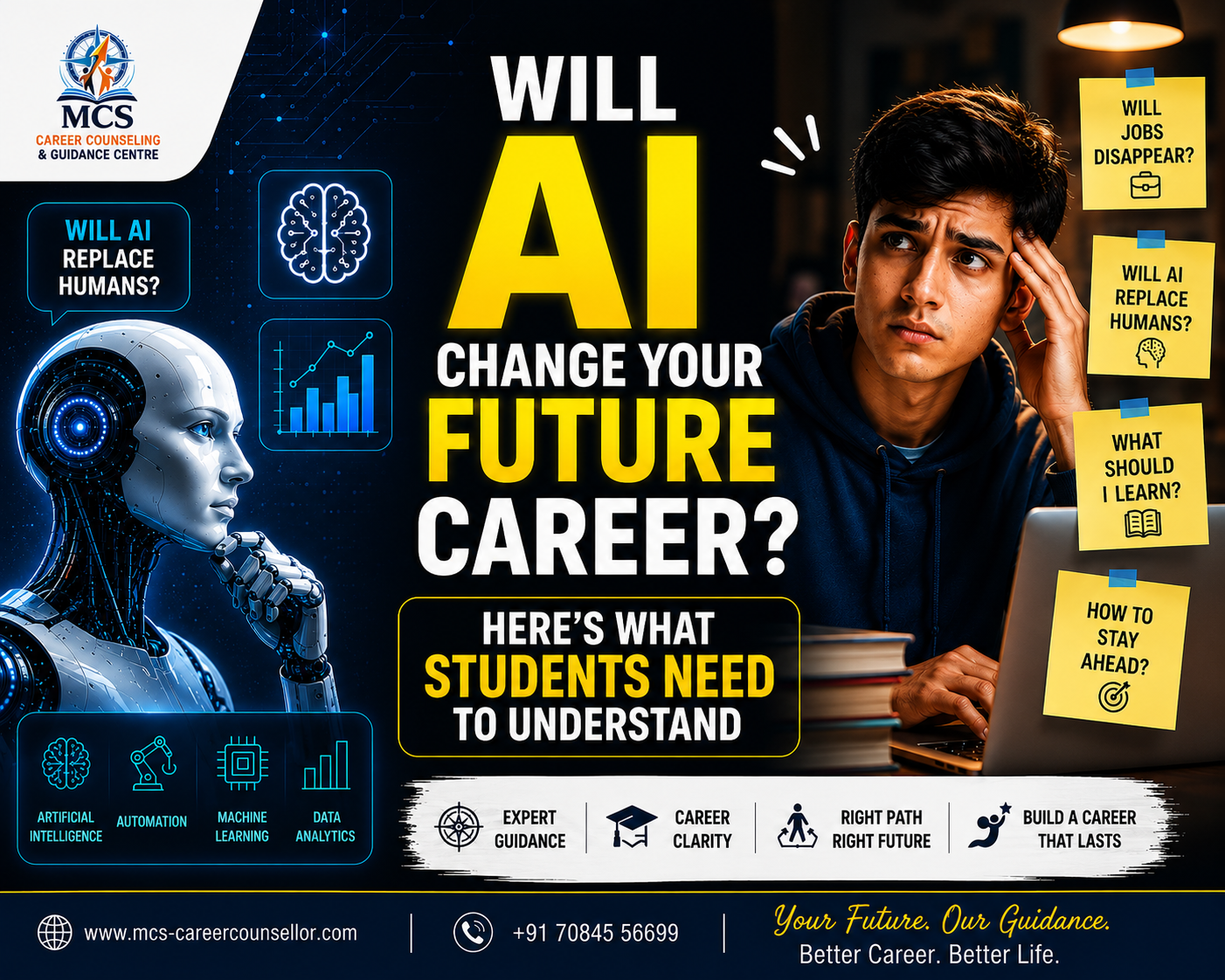
Will AI Change Your Future Career?
A few years ago, career decisions felt much simpler. Today students are mostly worried about getting good marks, choosing a stream, finding a stable career and making parents proud.
But somewhere in the last few years, things changed very quickly. Career options in AI, automation, machine learning, ChatGPT and digital skills are increasing, and it's creating confusion. A lot of students today quietly wonder:
Will the career I choose today even exist after 5 or 10 years?
And honestly, that's not an overreaction anymore. Because Artificial Intelligence is changing the way the world works faster than most people expected.
But here's the thing students need to understand clearly — AI is not only changing jobs. It's changing the way students should think about careers. ## The Old Career Formula Doesn't Work the Same Way Anymore
For years, students followed a very fixed idea of success. The formula looked something like this:
> Good marks → Good college → Good degree → Secure job
And while education still matters, the reality looks very different today. Companies are not only looking at degrees anymore.
They're looking at practical skills, adaptability, communication, creativity, problem-solving and digital awareness. The world has become skill-driven and AI is speeding up that shift.
Students Are More Confused Today Than Before — And It Makes Sense
One of the biggest reasons students feel overwhelmed today is because they are exposed to too much information all the time.
Open Instagram or YouTube for five minutes and you'll hear:
- AI will replace jobs.
- Coding is the future.
- Traditional careers are dying.
- Only tech careers have scope.
After hearing all this repeatedly, many students start panicking. Some feel pressured to enter fields they don't even enjoy. Others feel scared that their interests may not have a future.
But career decisions made from fear usually create bigger confusion later — because the truth is not every student needs to become an AI engineer to succeed in the future.
AI Is Replacing Tasks — Not Human Potential
This is something students really need to understand properly. AI is excellent at handling repetitive work. It can organize information, analyze patterns, generate basic content, automate routine tasks and save time.
But there are still many things technology cannot replace. AI cannot fully replace:
- Human connection
- Emotional understanding
- Creativity
- Leadership
- Empathy
- Original thinking
And interestingly, these human skills are becoming more valuable now. That's why careers involving psychology, counselling, branding, design, teaching, leadership, strategy and communication are still growing strongly — because no matter how advanced technology becomes, people still connect with people.
The Future Belongs to Students Who Can Adapt
Today people switch careers more often than ever before. Students studying Commerce may enter digital marketing later. Art students may work in UX design. Science students may move into business analytics or startups.
Why? Because learning has become more flexible.
Students now learn through online courses, certifications, internships, freelancing, communities and real-world experience.
Some Careers Are Growing Faster Because of AI
While students often focus on jobs disappearing, they don't notice how many new opportunities are growing at the same time.
Industries expanding rapidly include careers like:
- Artificial Intelligence
- Cybersecurity
- Data Science
- Digital Marketing
- Product Design
- Mental Wellness
- UI/UX Design
- Content Strategy
- Renewable Energy
- Business Analytics
Students Should Focus Less on "Safe Careers" and More on Valuable Skills
A lot of students still ask which career is safest? But the better question is — which skills will stay valuable no matter how industries change?
Because industries will continue growing. Technology will continue evolving. But students who build strong human and practical skills will continue finding opportunities.
Some of the most important skills students should develop now are:
- Communication
- Confidence
- Creativity
- Critical thinking
- Emotional intelligence
- Digital literacy
- Adaptability
These skills help students grow in almost every field.
The Mistake Students Make
Many students are choosing careers only because they look successful online. Suddenly everyone wants to become a coder, enter into AI, build startups or become content creators.
But career success doesn't happen because something is trending — it happens when your strengths, interests, personality and effort all work together.
Parents Also Need to Understand How Much Careers Have Changed
For many parents, career advice still comes from the world they experienced themselves — and that's understandable. The career landscape today is very different from what it was 15 or 20 years ago.
Students today are entering careers that didn't exist earlier, are globally connected, skill-based and are evolving constantly. That's why students need more guidance, exploration and open conversations, instead of constant pressure and comparison.
Sometimes students don't need someone to decide their future for them. They just need someone who helps them understand themselves better.
Final Thoughts
AI is definitely changing the future of careers, but it's not the end of opportunities for students. In many ways, it's creating a future where students have more possibilities than previous generations ever had.
The students who stay curious, keep learning, build practical skills, understand themselves and adapt confidently as the world changes, will be more successful.
Because in the end, career success is not only about choosing the right career. It's about becoming someone who can continue growing no matter how the future changes.
Frequently Asked Questions (FAQs)
Q1. Will AI replace all jobs in the future?
No. AI replaces repetitive tasks, not human potential. Careers involving creativity, empathy, leadership and communication will continue to grow.
Q2. Which careers are safe from AI?
Careers that require human connection, emotional intelligence and creativity — like counselling, design, teaching, leadership and strategy — are less likely to be replaced by AI.
Q3. Do students need to learn coding to succeed in an AI world?
Not necessarily. While digital literacy is important, not every student needs to become a programmer. Focus on building skills that align with your strengths and interests.
Q4. How can career counselling help students navigate AI's impact?
Career counselling helps students understand their unique strengths, explore suitable careers and create a plan that works in an AI-influenced world.